
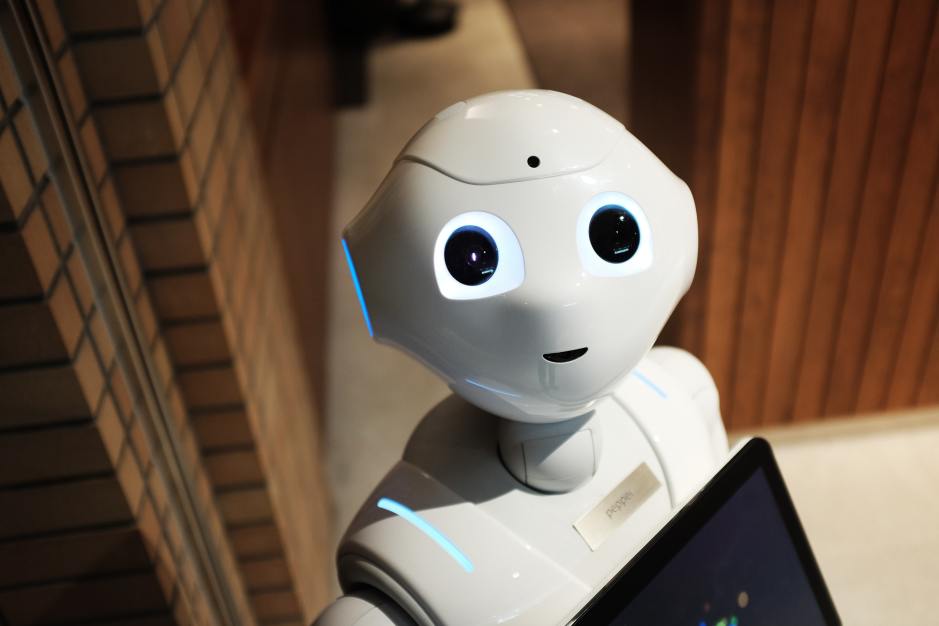
This week’s lecture was online-based which made it less hands-on than the two previous weeks (or did it? I mean doing technology class online makes sense… right? 😏)
Nonetheless, I thoroughly enjoyed a more theoretical and philosophical approach to exploring ideas behind technology and its positive and negative impacts on the students. Just a little warning before I continue: this post will definitely be a bit longer and a bit more serious. It will also be a bit more rambly as I am currently up during the early (or late, it’s all about perspective) hours of the day, trying to sound intelligent so my sincerest apologies in advance!
Now after we’ve put the service announcement out of the way, let’s begin!
Up to this point, I believe that I have had mostly positive feelings on all the new technological knowledge I have been acquiring, because it’s, well, new and of course, exciting. I can also understand the many uses that technology can have within the classroom. However, it is always a good idea to take a more critical look at bigger questions that many of us might have about technology, such as, for example, where its place might, could, or should be in music classrooms. Below, I will discuss several different views which we have studied in our online class.
The good and the bad of technology
In his TED Talk, Professor Sugata Mitra discusses how the future of learning might look if we move away from the, ‘Victorian system of school’ (ie. the current model of classroom teaching) that was meant for, as he put it, ‘bureaucratic administrative machine’. In other words, he argues that schools were meant to churn out individuals that were all relatively the same with similar set of skills. However, the world today is much more complex and driven by factors that do not relate to the past model as much. He backs up his theory by presenting the results from his research and explaining that children could potentially self-learn with the aid of technology.
Initially, I was very, VERY impressed with Mitra’s incredible research (please check out his TED talk, it is inspiring!). The innovation of his approach the incredible results he achieves are truly worthy of admiration and possible future implementation in schools. However, there was a specific statement that he made which caught my attention: “It’s not about making learning happen, it’s about letting it happen.” Though I do agree with Professor Mitra’s conclusion, it is not necessarily in the same context.
Let me explain.
I believe that technology is a great aid towards self-learning and can truly help the students grow as learners. However, to argue that technology is the only or, at least, best way in allowing the students to learn effectively as opposed to old-fashioned classroom teaching without any aid in technology is, at least in my opinion, not entirely correct. The problems that might arise with overly outdated learning models in schools isn’t due to lack of technology but due to the way learning is seen by many teachers and school administrators. It is the lack of critical thinking and self-learning, whether it be with or without technology, that is the problem and technology offers one solution towards a more creative approach. In fact, I am convinced that Professor Mitra’s same experiments could’ve been done without any technological aid but maybe with rather colourful books and clear visual aids.
Also, even if we do say that students can self-learn by using the resources provided to them by the amazing world of the 🌈⭐INTERNET⭐🌈, what ends up happening many times is that the students end up seeking help from experts (like teachers) once they feel they can’t continue by themselves anymore. Musical Futures informal way of learning in music classrooms is a good example of how children can learn well by being allowed to freely explore musical concepts and goals such as, for example, being able to learn how to compose a short song on a guitar. Steve Sajkowsky, a content developer and trainer for informal learning in Melbourne, mentions in his interview* his pleasant surprise at how effectively the students were able to achieve the given goals as long as they felt safe and comfortable in their environment which informal learning provided for them.
*Unfortunately, I am not able to provide you with the video as it was specifically recorded for our online lecture
In saying that, I do think that Professor Mitra’s research is still quite impressive and teaches a huge amount about the way children can respond to technology positively if used correctly in the right setting.
On the other hand, Dr Dimitri Christakis in his TED talk argues against over-stimulation that technology can have on the young minds which can in turn lead to drop in attention span. However, this is only with technology that seems rapid and fast changing. Technology and media are not intrinsically ‘bad’ but unfortunately many programs for children encourage the short focus through quick and exciting pacing. As a future music educator, this is definitely something to take to heart. Through my desire to make learning more exciting and new, I need to be careful enough not to over-stimulate the students but rather always try and allow for some space for reflection and quiet thinking (not an easy feat to achieve in music classrooms!).
Cognitive load theory and website design
During our online lecture, we also touched on cognitive load theory and how to cater to students in a way which won’t overwhelm them with information when presenting PowerPoints. In summary, what we say shouldn’t also be written down and vice versa. Instead, we should accompany our lectures with visual cues and key words which will help them understand and remember the auditory input given by the teacher.
We then moved onto website design and how we can properly apply the ‘F shape’ visual design which caters to how people’s visual attention usually lingers at the top and the left hand side of the website. A little more about it here.
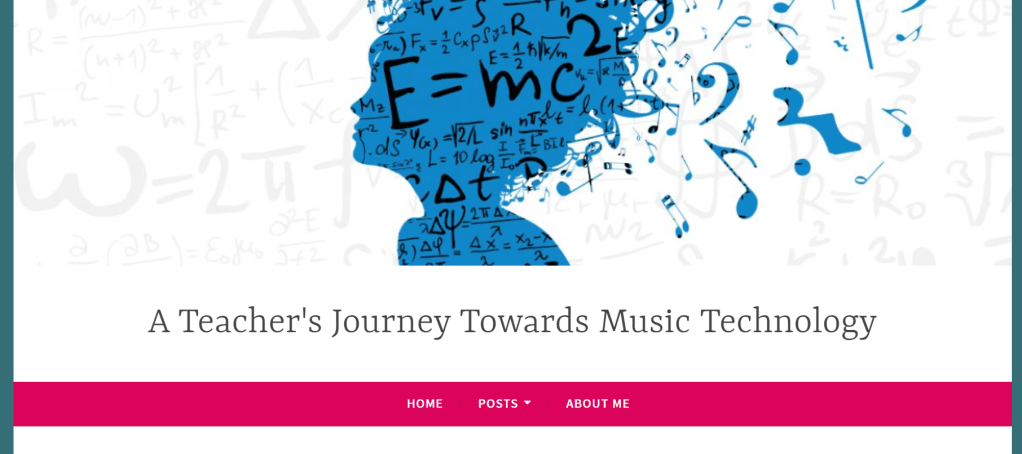
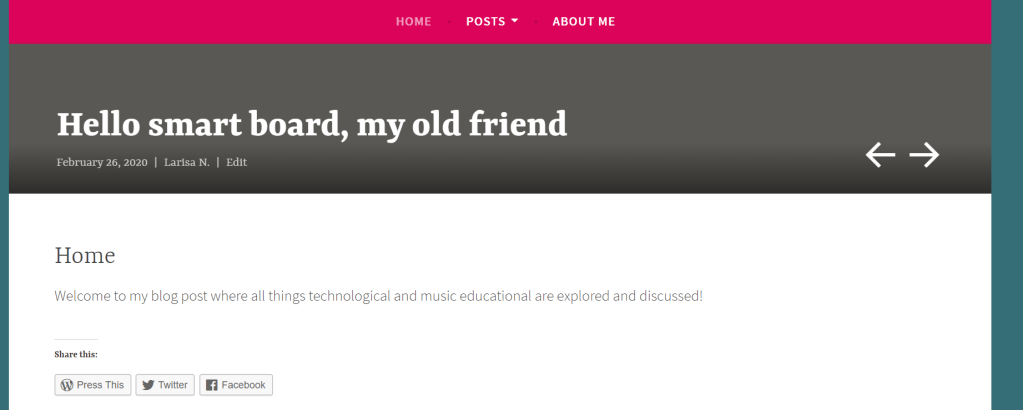
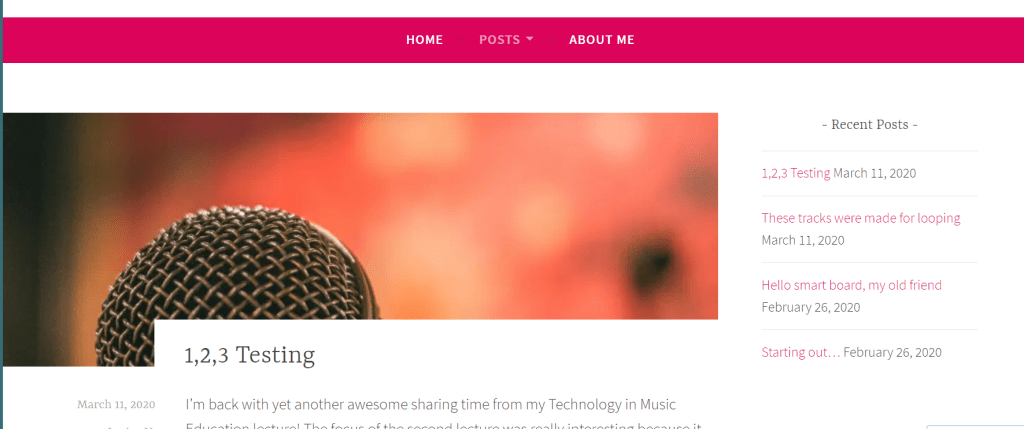
Our lecture James has tasked us to think critically about our blog page (the very one you’re reading!) and think about how we could improve it so it is more engaging to those visiting the blog. I have decided to change my original design purely because I didn’t like the colours and the themes. However, the actual visual presentation of it was quite good as it had all my main pages at the very top, easily accessible to all blog visitors. The posts themselves were also aligned to the left of the page which can immediately grab the reader’s attention. I am still not completely satisfied with the way the blog looks and will hopefully experiment more with it over the weekend. However, I believe that my aim of creating an easily accessible blog page was achieved for the most part in both my old and new designs, though not my aim for maybe a more visually exciting design.
Here are some photos of the old design:
Anyways that is all for this post! Please let me know your thoughts on how you perceive technology in classrooms (or in general)! And until then, I am off to count the sheep 🐑.
 Exploring Technology in Music Education