
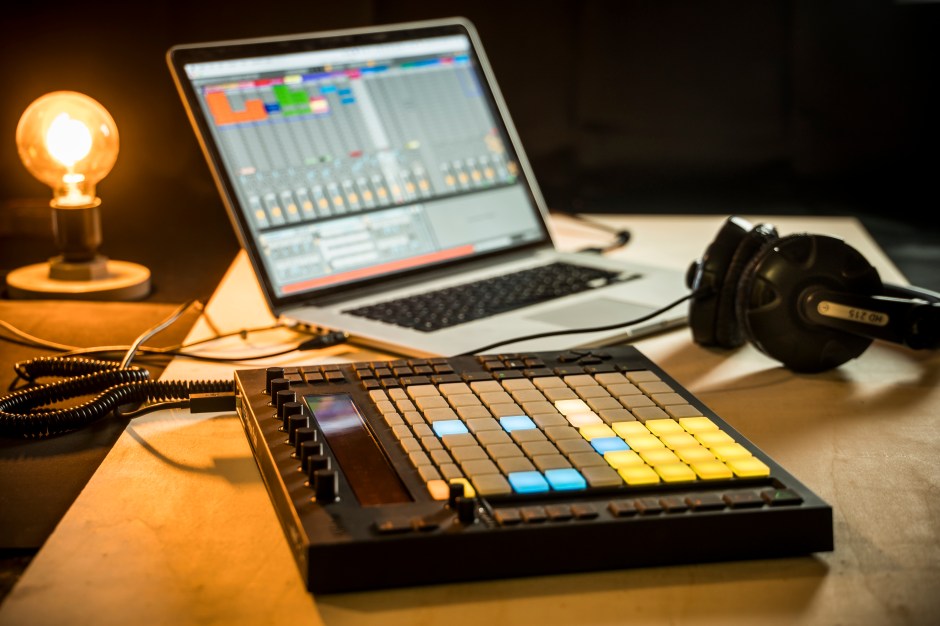
Hello and welcome to my cooking blog where I teach you how to mash things together until it all kinda makes sense and doesn’t taste (ie sound) bad. 😁
Of course I am not talking about actual food, though the food similes at the moment could be a result of a missed lunch. That’s ok, there’s a pizza with my name on it waiting for me. Until I get to munch on it, however, let me tell you a little bit about Ableton Live and how it can apply to teaching as well as your own creative musical outlet.
I wasn’t very familiar with Ableton Live; in fact I have never even heard of it. This could probably be due to the fact that I am not into EDM or similar music genres. I also am not very familiar with different music production software so this whole lecture was, yet again, a completely new learning experience for me. I will be honest and say that I probably won’t pursue music sampling and mashing further than what I’ve learned in my lecture, at least not in any foreseeable future, mostly because this is not my area of interest. HOWEVER, in saying that, I have still gotten quite interested in the implications music sampling might have within music education, especially if teachers are looking for more innovative ways in teaching composing, even improvising. James, our lecturer, has as always recommended some extra sources and videos to check out in order to acquire a wider understanding of the topic at hand. I will, of course, talk a little about Ableton Live and the small activity which James has given us during class time. However, I find it even more fascinating to look at the more philosophical look at what music teaching is and how it could potentially look if we encouraged a greater range of avenues for music making.
Exploring the big ideas
“Most meaningful music education right now is happening outside of classrooms” was what Ethan Hein, one of the panellists in the video, has said. ‘Woah, that’s a radical statement!’ you might think but he isn’t necessarily wrong. With the amount of technology and resources available to us online, it really is not surprising that many young children and adolescents are exploring music making at home. Especially if they feel that their formal music education is not contributing to their interests and creativity. Abletone is a company that is promoting exactly that: a culture of self-learning. Also, music genres like EDM and hip hop are being put on the forefront of music creating AND education, which really encourages a large group of people to create music they actually enjoy to listen.
Interesting thought that has been put forward in the video by Ethan and another panellist, Melissa Uye-Parker, is that certain practices of learning music in western musical institutions have been established in 18th and 19th century aristocratic Europe and might not be very useful in music making beyond of their intended purpose, ie. performing for the wealthy and the aristocratic Europeans.
I would have to say that I don’t necessarily agree with this statement mostly because ‘old’ traditions which have been have been design within certain cultural contexts don’t necessarily have to remain in that context and can be very much relevant for today. Even something like composing chorales can be translated into a plethora of different styles if you’re creative enough. The video below shows a fugue composed with musical sample from Lady Gaga’s Bad Romance (which sounds absolutely fantastic!):
Traditional music making in the western tradition really is, and I’ll use a phrase also mentioned in the video, another tool in the shed that a musician can really benefit from. Personally, I wish I had an even stronger grasp on music theory as I feel it would provide me with greater array of skills. Who is to say that you can’t create a hip hop chorale? Kanye West has composed an opera (though this article in The New York Times would classify it more as an oratorio), mixing hip hop and gospel music with certain sections of the opera sung in Latin. There is the possibility that I have misunderstood the statement made in the video but either way, it is a good thought exercise to think how your previous musical exposure and education can be connected towards the new ideas you might encounter, like myself in this week’s lecture. Instead of rejecting the old and on with the new, I always try and advocate for a collaboration between the two. Some might even say a mash-up 😉
Ethan continues talking about some of the educational uses of Abletone Live for his guitar students, from changing the key or the tempo of a song to using beat grid beats instead of metronome. All these suggestions and tips are very useful and I definitely agree that Abletone Live can be a great tool!
I have personally used a few apps on my phone and Ipad when teaching violin which I found quite useful as well so I fully support the use of technology even during private instrument lessons!*
*In case you would like to know what apps those are, I’ll mention it here but you can skip this part of the blog if you’re not interested. The apps themselves are nothing extraordinary but I can say that even something like a voice recorder can prove rather useful when practising that one tricky passage. The first app that I love is called Drone Tone Tool (also a browser program) and Metronome Beats (the Pro version). Drone Tone Tool is very useful for intonation practice which comes in handy with string instruments or singing. I usually recommend my students to use this app if they’re struggling to play a particular scale or stay in tune with their singing. For the most part, I have found it to work really well in improving the students’ listening skills. The metronome app, on the other hand, has a lot of useful options such as increasing clicks per beat, choosing how many beats are in one bar, tapping your own tempo, saving your own beat construction for particular pieces or songs you’re practising and more!
Overall, I found the video quite interesting and it has definitely educated me on how music educators not only approach teaching music technology but are also changing the way music is being made. The one critique I would have to give to some of the speakers was the fact that at times it felt as if there was some sense of superiority due to creating music with technology and a way of looking down on the traditional Western musical traditions. For me personally, one is not better than the other, as I have discussed earlier. Saying things like ‘Rap is more interesting than most western music tradition’ is not necessarily beneficial for anyone because that is a very subjective statement. Every type of music and way of making music holds interest and tells a story of how people relate to music. Some may feel incredible inspiration in expressing themselves through rapping and some may feel incredibly creative when composing a symphony. I would just be careful as an educator to stay away from such generalised statements.
Nonetheless, I was still very much inspired after finishing the video and my world was made better by knowing of all the amazing possibilities programs such as Abletone Live are able to achieve and inspire in students. Again, Abletone Live may not be something I’m interested in exploring further (at least not for now) but I acknowledge and admire its great possibilities.
DJ-ing is cool ok?!
There are definitely some misconceptions I would like to address that I might have had about artists who sample and remix music (DJs), one such misconception being that it is not actually that difficult to DJ. In fact, it is not even real music making. To be fair, I didn’t necessarily have such a strong opinon of mash-up artist but I was definitely perplexed with the whole process. I guess it’s easier to just say something is dumb if you don’t understand it.
During the lecture, James has showed us a few examples of mash-up artists who really make some amazing work! And how do I know that they are doing amazing work?? Well we attempted to do some mashing ourselves throughout the lecture, first in Soundtrap and then in Abletone Live and let me tell you, ’tis not but a simple task. James was kind enough to have pre-made samples from many different pop artists (which I have downloaded all for future teaching needs!). This is how it looked:
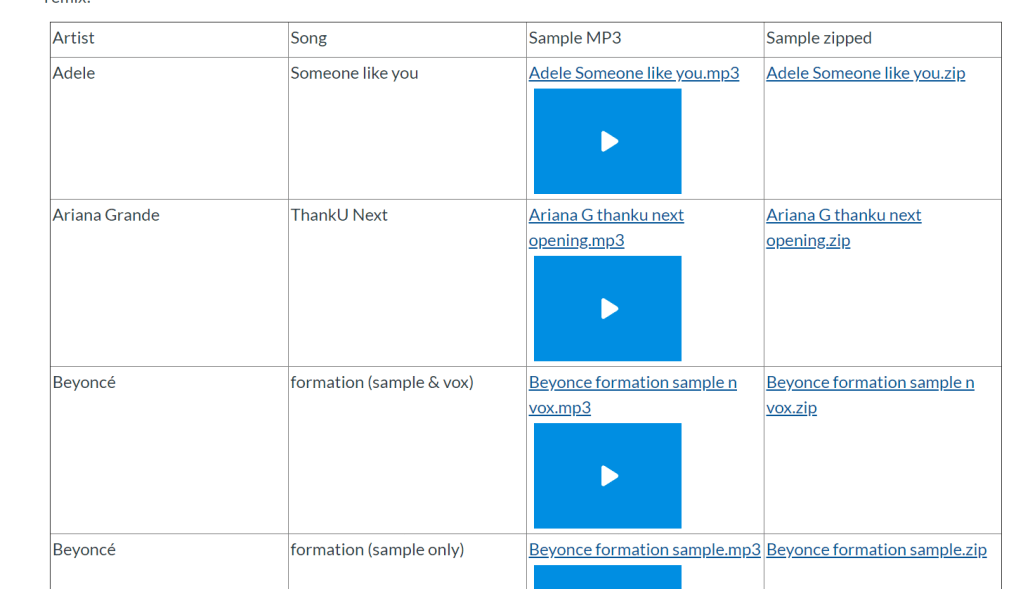
We were required to choose two samples, put it into Soundtrap and experiment with mashing. And yeah, mine was really not good at all. I won’t even bother posting it here because it really wasn’t great… But I learned a valuable lesson – Don’t be a snob!
I admit it, I was definitely a snob when it came to music mashing but the amount of precision and vision you need to have in order to find some connection between the two seemingly different music clips, not to mention a few dozen or even a few hundred, is actually very impressive and incredibly creative. Here is a piece of work by Girl Talk, one of these well-known mash-up artists, who we briefly mentioned during the lecture. After going through the whole Soundtrap ordeal, his work sounds even more impressive! Have a listen!
*Just a warning that the music track has some very explicit lyrics *
The next video is from Pogo (to whom I have actually subscribed now because he is so cool!) and he makes music out of mash-ups from different movies (at least from what I’ve gathered) but mostly Disney, which is an immediate win in my books! This video below is actually from Mrs. Doubtfire and it’s soooo good!! If you don’t have time for anything else, at least listen to this 3 min mash. It will make your day a little bit better, I promise!
Also here’s some Disney mash-up cause why not:
I should probably mention before I go on that these mash-up artists might create their own beats and certain musical ideas which they incorporate into their final mix. You can definitely hear it in Disney mash where the melodic ideas come from Disney princesses speaking but there is a consistent original beat that binds the whole video together.
The one mash-up artist I was impressed with the most, however, was DJ Madeon who learned music making and producing from the comfort of his own home as an adolescent. He is not a well-known artists who even gets opportunities to produce music for famous like Lady Gaga. And he’s only 20! Really makes you think! :O
The video below shows Madeon performing a live mash-up (when he was only 14 or 15). James has actually done a musical analysis of the video, if only to prove to those unbelievers (such as myself) that this is a very complex way of making music and it definitely has its place in the music world. It was after this video analysis that I truly began to appreciate the effort and creativity which goes into mixing and DJ-ing. Have a look at Madeon’s amazing performance (without the analysis annotations unfortunately):
In saying all of this, I should probably show you what I’ve done in Abletone when we had the chance to experiment a little with the program. Just brace yourself though, it is pretty basic and not at all exciting haha…
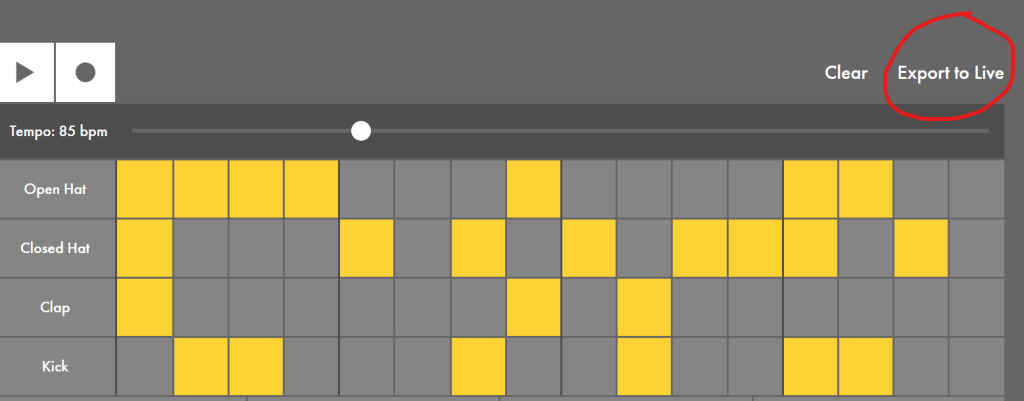
The way we were told to try and experiment with Abletone was to first create a beat on Play With Beats Abletone website. I had a beat of fun (haha punny…) experimenting and then settled for one sound which I Exported to Abletone Live. The whole process was super easy because all I did was click this button:
After the beat was successfully exported, we were required to add our already-chosen two samples were told to make a synth bass in Abletone. Mine didn’t come out very tight as I had to use my computer keyboard (which lagged) for playing instead of the actual midi keyboard.
The way you get to the midi keyboard is to click on Analogue in the Instruments section and then make sure that the little keyboard icon is on :
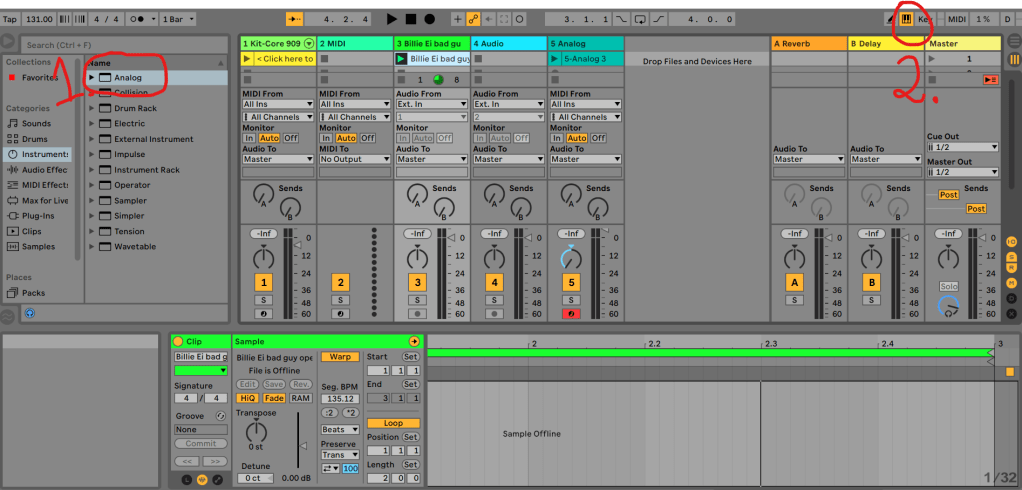
The final product of all this mashing and technologicking was this (I took a screen capture of my mash-up as I didn’t know how to export the file):
Of course, this won’t win any awards but it was a definite improvement from whatever I attempted to make in Soundtrap. Trust me.
And again, I probably won’t pursue this avenue of music making any time soon but to know at least a little about how it works and where I can start if I ever to want to become better at mashing is so, so useful. Though I might have not enjoyed the actual process (because I wasn’t good at it haha and that’s just a perfectionist in me talking), I can see how useful Abletone Live might be for inspiring young students to get creative with music they might actually encounter or listen to in their every day lives.
I would like to end this blog with a video that I have wanted to discuss for a long time now. In here, Billie Eilish and her brother Finneas describe the creative process behind making and producing ‘Bad Guy’ . Incredibly, the whole album and not just the song was produced in the comfort of their own home. I thought it was especially interesting how certain random sounds (like the sound of the traffic light in Sydney) was used and produced into a track. It really shows that music sampling and music producing is a craft of its own and should be valued as much as composing a symphony. Of course, I’m talking to myself, a very sheltered classical musician who is only now beginning to discover the joys of current music-making trends.
I hope you have learned something from this post and it has maybe gotten you to re-consider certain pre-conceived notions you might have had, like the ones I did coming into this week’s lecture. And if you haven’t discovered the joy of music mashing (don’t listen to me, it is actually quite fun!), have a go and see where it takes you! 🙂
 Exploring Technology in Music Education