

So folk, here were are. The second last week before the end of this semester and thus, the end of Technology in Music Education unit. Next week, our class will have the great privilege of hosting Ethan Hein (more about him in the next blog post!) but because this week is technically the last time our amazing lecture James Humberstone will have the opportunity to lecture us, he has decided to round up the whole unit by having another very important discussion on the benefits of taking a break from technology.
Amusingly, James mentioned how many of his past students have told him about the meaningful impact this particular lecture has left on them. The irony didn’t escape him, considering he teaches a whole unit ON technology. And yet, I have to agree with his students because there have been some serious problems with my own relationship with technology which I’ve always wanted to address.
Digital Distraction
Digital distraction has become a serious problem with many people in our modern society and it is hard not to notice the patterns which have led us to that problem. For the first time in history, people are connected more than ever due to the incredible advancement of technology. Thought we might be used to it, there are times when I stop and think about how mind-blowing it would be for someone from the past (if time travel were possible of course) to witness me having a group chat with my friends from Canada and then immediately after the chat, making a call to my grandparents in Croatia. Information travels faster than it has ever travelled before and within a few minutes, I can be updated about the current news anywhere around the world. I believe that many will agree with me when I say that during the current COVID-19 pandemic, the only reason to why we are still able to have uni classes, do our work is all thanks to technology!
So yes, on one side, technology has become an incredibly important way of life. Unfortunately, with something as powerful as that, there is always a ‘but’ and if we are not careful on how we utilise it in our everyday routine, it can become incredibly addictive and distracting.
During the lecture, James made a comment about research which looked at the effects of our smartphones on our levels of distraction. I forgot to write down the name of the paper so I decided to do some of my own research and see what the most recent and common consensus is. I haven’t had the time to do a proper deep dive but there is one paper which I thought summarised the topic of digital distinctiveness quite well.
In their chapter, Éilish Duke and Christian Montag discuss the specifics of smartphone addiction and its relationship to internet addiction. They do make a mention of smartphones being very useful tools that can actually aid people’s productiveness. Nonetheless, if not controlled properly, smartphones can actually negatively affect our ‘flow’. Duke and Montag describe this concept, originally coined by an Hungarian-American psychologist Mihaly Csikszentmihalyi, as “a positive state of full concentration where one’s own cognitive abilities are matched by the difficulty of the given task.” The auditory and visual stimulation we receive from our smartphones, especially if close to us when we attempt to be productive, can severely impact the efficiency of our work.
These kind of habits of needing to constantly be close to our smartphones develop quite easily. Just a simple action of checking your phone while on public transport during ‘dead time’ when nothing is happening, immediately programs us to do it whenever we feel bored or need an excuse to procrastinate. And soon, the need persists even when we are incredibly busy and have many tasks to finish. I personally feel this ‘need’ quite a lot and have sought my phone often as a way to distract postpone working on that one assignment or writing that one blog post *cough cough*.
The way to combating these levels of addiction is to consciously lower the time spent on devices by devising personal-targeting strategies. James mentioned something he does with his family which I would absolutely love to try out myself! During hours spent with family in the common living area, all their phones go into a multi-usb charger port so when any of them want to check their phones, it becomes a conscious decision. In this way, they are able to solely concentrate on their time together. Another thing that I have been testing out for the past few weeks is turning off any notifications from Facebook or emails for one day. It has really been a good way to cleanse from any stress associated with the constant flow of information.
However, in terms of strategies to help your work flow and productivity, technology can actually be quite beneficial! First of all, I have been recently trying to remove my smartphone from my reach or view when I work on assignments. Even the simple action of removing it out of my sight makes me feel more focused and less inclined to procrastinate. However, while we’re on the topic of procrastination, this might come as a surprise to you as I have been so good at writing these blogs every week (🙄) but I am severely guilty of doing it. All. the. time. It is possible that this is a symptom of having a perfectionist personality. However, what I have noticed is that if I don’t properly plan and prepare myself, stress of completing tasks gets to me easily. So, how can technology actually help in solving this problem even though I just said that it oftentimes distracts me?
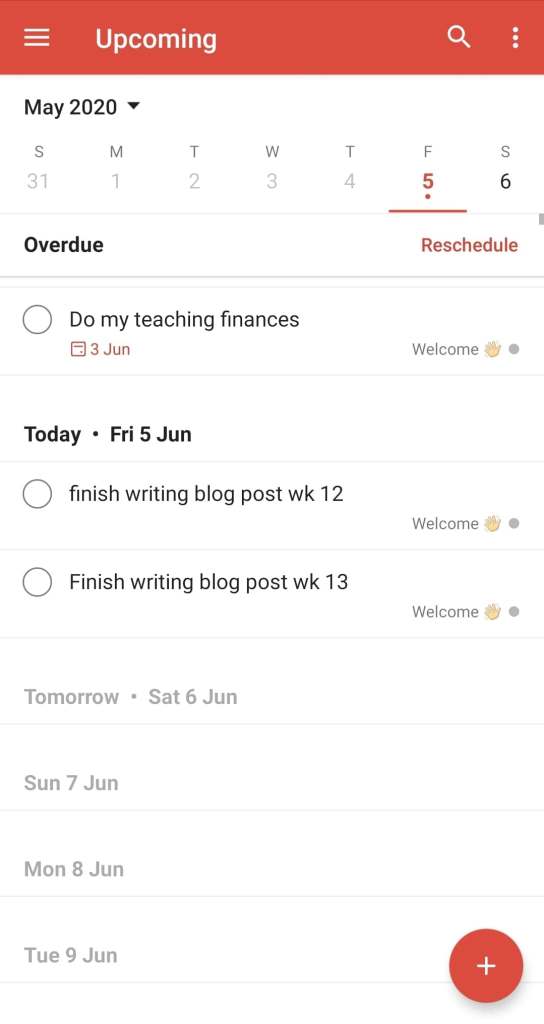
Well, let me tell you about two of the apps I’m absolutely loving right now! The first one is called Todoist and has been recommended by James in his lecture. I’ve immediately downloaded it and began using it! It is basically a checklist app that helps you organise all the tasks you need to complete and even sends you notifications every day to provided you with an extra reminder! I absolutely love it! The mere act of checking off the task provides such a feeling of accomplishment, even if the task is small. The app helps me organise my thoughts and often, I will make sure to check it and update it before I go to bed. This helps me in not getting distracted with all the things I need to finish when trying to fall asleep. This is how my list is looking at the moment:
Another app that I find helps me wind down from all the stress and distractions, especially when needing to fall asleep, is Headspace! Unfortunately, to get access to a lot of the features, you need to pay for subscription, which of course I wasn’t ready to do. Nonetheless, I tried out the free version and I loved it, despite my scepticism about mindfulness exercises. The ones I’ve enjoyed the most were the Sleepcasts that have been miraculous in helping me fall asleep when a lot of thoughts buzz through my mind.
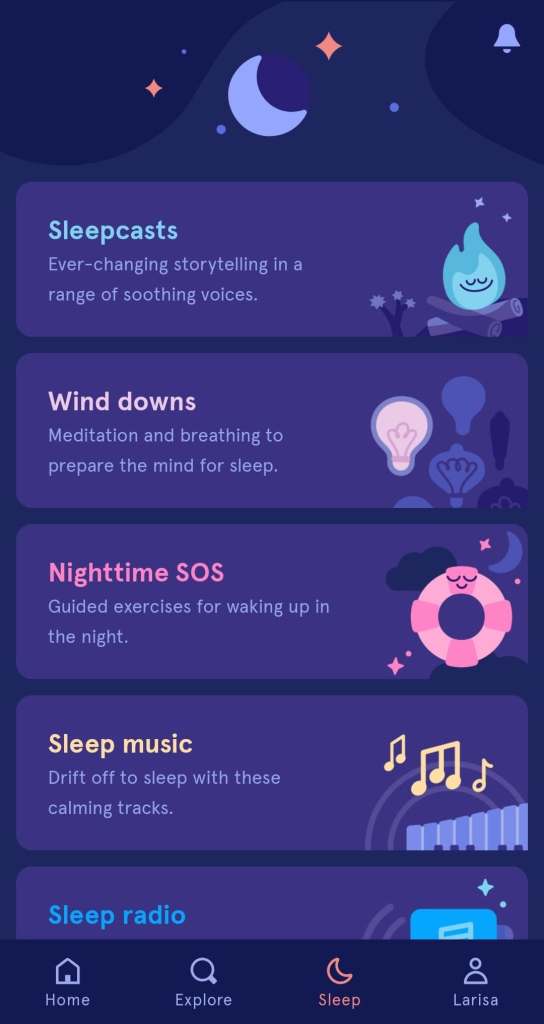
In the end, this poor student did end up paying a year of subscription and I haven’t regretted it! The app also provides mindfulness exercises for a number of different situations so be sure to check it out through Headspace’ free trial! ☺
Some personal reflections
I have to say, the whole unit has been a wild ride and I have learned A LOT throughout these 12 weeks. There is so much that I would love to explore further and develop in my own personal time. For example, I know that I’ve said Abletone Live is not something I am interested in exploring any time soon, but hey, a gal can change her mind and in this case, this gal would definitely like to tackle the software a bit more. There is a lot of potential for educational uses which is why I’m aiming to become more proficient in it once I find the time to sit down and watch hours and hours of tutorial videos. 😏
Something else that has inspired me in pursuing skill development, specifically within music technology, was seeing my fellow Music Education peers pursuing personal professional development even after graduating from uni. Caitlin Sandiford, part of an amazing string quartet called Quart-Ed (I know, it’s a brilliantly punny name!) made up of music educators that not only perform together but also focus on creating educational content and resources, has recently posted a video about her own journey of taking up a course in music production by Andrew Huang. One of the projects in the course led her to composing and recording an original song. She explains the whole creative process in this video so you should definitely check it out! Also make sure to check out Quart-Ed’s Facebook site! They do some amazing work and provide very unique and exciting approaches to music education.
❗‘Would you like some cheese with your corny conclusion of this post’ alert❗
Coming into this unit, I have been prepared to do a lot of work that I don’t necessarily find relevant. I have also previously heard the unit to be relatively demanding and therefore didn’t really see how I was going to find much enjoyment in it. Music technology unfortunately wasn’t something I found particularly interesting.
But boy am I glad that my opinions soon changed. Yes, it was a lot of work and yes, I did feel sometimes a bit too overwhelmed when trying to understand how a specific new software works within 2 hours (looking at you Abletone Live 👀). Even so, I realised that there is so much outlet for us as musicians to express our creativity and, in my personal opinion, technology really provides a broad spectrum! I have discovered a new love for video editing which I never thought would be possible. I have also felt inspired to continue the ‘let’s learn new skills’ train and take up projects like learning how to play the ukulele. I haven’t written more about my ukulele journey but I have been playing for the past two months and slowly getting better. To be honest, it feels great to be able to develop new and practical skills which I haven’t pursued in so long due to busyness and distraction. Soon I will try and buy a new keyboard to keep on developing my not very impressive piano skills! 😃 In fact, my head is exploding with new project ideas I would love to tackle, so if this unit has taught me anything, it is to look for inspiration and creativity in many different places.
I hope that you were able to get something from these blog posts, if only to see through the eyes of a music technology newbie. As musicians and music educators, we play a very important role in inspiring those around us to see the beauty and creative power music can have on everyone’s lives. Having the ability to explore music through these new technological avenues taught me this and I hope that the journey never stops. Not for me nor for you.
I only hope that we always continue sharing and caring about music and music education together. Surely then great things will happen wherever we go! 😃🎶🎵
Research quoted in this blogpost:
Duke É., Montag C. (2017) Smartphone Addiction and Beyond: Initial Insights on an Emerging Research Topic and Its Relationship to Internet Addiction. In: Montag C., Reuter M. (eds) Internet Addiction. Studies in Neuroscience, Psychology and Behavioral Economics. Springer, Cham
 Exploring Technology in Music Education