
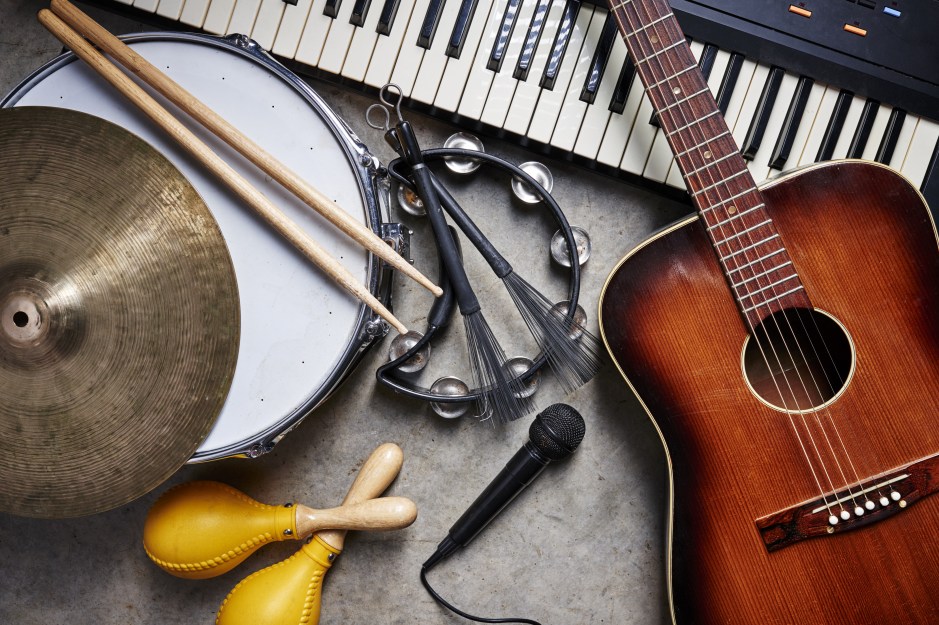
After our first video chat on Friday April 24th, Lucy and I have decided that it would be best if we split the research between the two of us. We have also slightly revised our plan of making one instrument out of every instrument group as unfortunately, there is only two of us and a limited amount of time. HOWEVER, as we are both super keen on continuing this project even after TME unit is done (😢), more instrument designing is definitely in the books for the future! Yet for now, we have settled on 3-4 solid instrument designs. We have also made a list of all the videos that we could find of people creating instruments.
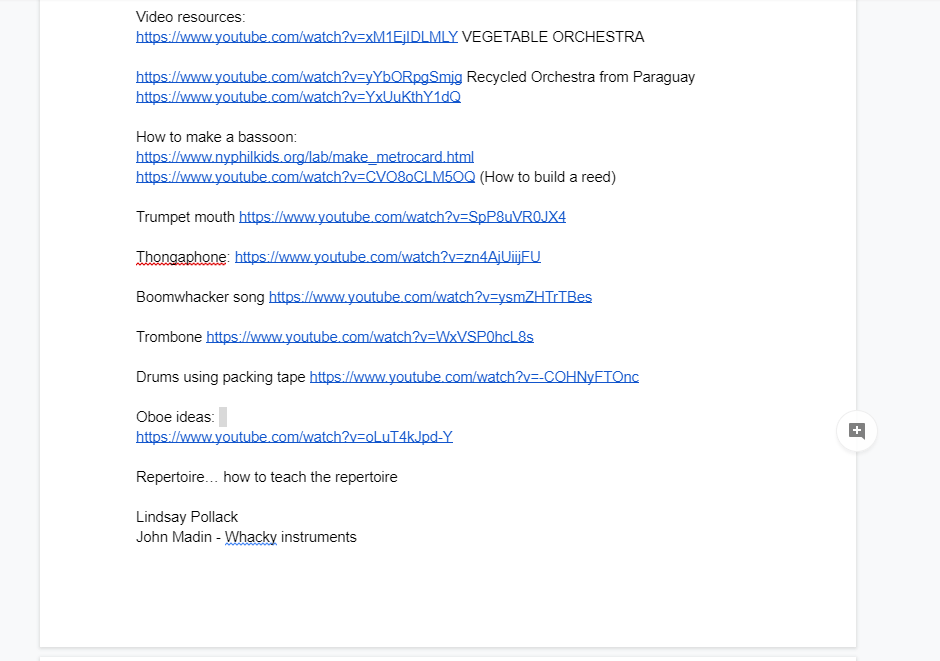

I have decided to look at the string instrument group and possible percussion while Lucy was happy to look at the woodwind-type instruments. She has been absolutely amazing with her exploration and has put herself to work immediately. Here is her blog post detailing the whole process into more detail!
Both of us also decided that it would be wise to have a conversation with James, our lecturer, about the direction of this project. There were definitely a few points which we weren’t sure about such as, for example, whether to make the instrument designs aimed at primary or high school students. Likewise, we weren’t sure on the amount of work we were required to present as a two-person group so yes, James’ help was definitely needed!
We arranged a Zoom meeting with him the following Monday and unloaded everything that we were thinking of doing up to this point (sorry James!). Thankfully, James encouraged our enthusiasm and recommended a few things in order to make it easier for us. In terms of whether we should do our project for primary or high school students, he didn’t have a preference so Lucy and I made the executive decision of concentrating on primary aged children mostly due to time restrains. We were worried that with high school, we would need to have much more complex instrument designs. However, that did mean that we would have to avoid using any power tools if possible. With these placeholders established, I also suggested to James that maybe creating a ukulele (or something close to it) would be a good instrument to try and create (of course with no power tools). He felt that this might be a little too ambitious for the amount of time or people Lucy and I had. I heard what he said, I agreed, and then I decided to do it anyways haha. Sooo, I guess we’ll see if it worked (you’ll have to wait till the next post to find out 😉).
Unfortunately, I wasn’t able to fully dedicate myself to starting to build instruments this early on as I had other assignments to catch up to before I was able to get my hands dirty. Nonetheless, I thought it would be good to help Lucy with instrument designs inspirations so I got to work. Lucy has already sent me a video of a potential design from Alexandre Cellier’s Facebook page:
I thought the idea was fantastic, very creative and, most importantly, it gave me an angle to focus on: old designs meet wacky. And what would you know, there were already a few people in Australia who are well-known builders of instruments, especially instruments which are adapted for educational purposes. In fact, there were two specific builders who both came to Sydney Conservatorium to offer us Music Education students some very interesting and educational masterclasses. The first creator was Linsey Pollak who specialises in woodwind-type instruments out of garden materials such as a hose, watering can and more! This is what his website (go check it out, it’s amazing!) says about some of his current projects:
“Since 1980 Linsey has also specialized in making musical instruments from various house and garden objects such as the garden hose panpipes, the watering can clarinet, rubber glove bagpipes, carrot flutes and carrot clarinets, chair flutes, broom clarinets etc. These instruments have featured in many of his shows such as Out of the Frying Pan, Knocking on Kevin’s Door, Playpen, The Art of Food, Making Jam, Passing Wind, Live and Loopy and Paper, Scissors …Rock! More recently he has designed hybrid wind instruments such as clarinis (narrow bore clarinets) made from aluminium, wood, bamboo and glass. There is also the Foonki which is a reed instrument which uses a plastic membrane (such as a garbage bag) as the reed which Linsey has been developing since 1999. Also, working with glass artisan Arnie Fuchs, Linsey has also developed glass bass clarinis such as Rosella and Mrs Curly (see below).”
The second creator that I was personally very interested in checking out was Jon Madin and his Wacky Instruments. His ingenuity left a huge impression on me about 3 years ago when he visited the Sydney Con. His instruments, unlike Linsey Pollak’s are more crazy and though the sound is not always great, it doesn’t matter because the whole point is to create wacky instruments which the students will have lots of fun playing! Here are some examples of them:
However, the reason why I wanted to specifically look at Madin’s designs is because of this instrument right here (start at 0:22 to about 1:50):
When I first tried playing on the Echo Cello, I thought the design was genius! It was fun, easy for primary school children to play on it almost immediately and most importantly, it made the students feel as if they were playing an actual cello. This one instrument really embodied everything Lucy and I wanted to achieve in our instrument making: a sense of fun and a sense of accomplishment for the students. Please go and check out Jon Madin’s amazing range of resources here!
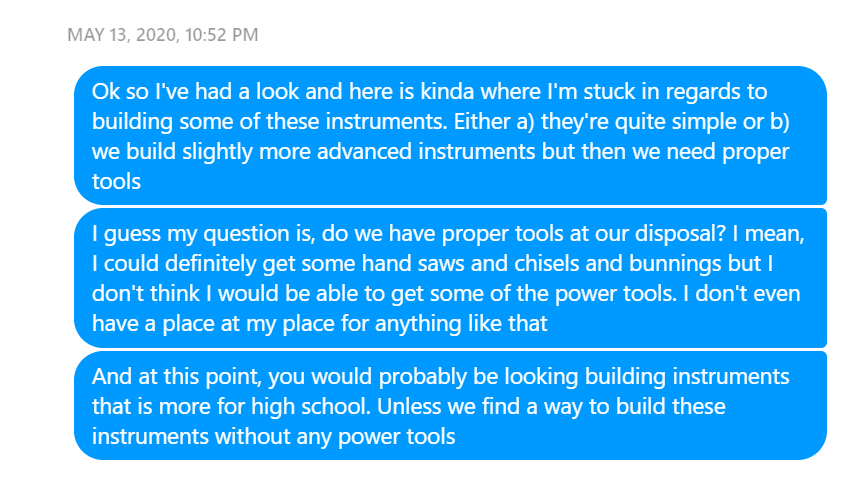
Unfortunately, the problem with an instrument such as an Echo Cello is that the design of it is quite complex and would require some power tools. I didn’t have the time to try and dissect its assembly. Also, I realised that I wouldn’t want to just copy someone else’s design completely. It would be better if I were to try and create my own Frankenstein version of some form of a string instrument.
I had a chat with Lucy to see what she thought would be the best option. We did both want to create a type of violin/cello instrument (as I do play the violin) but it was proving to be a more and more difficult process. I was also struggling with how simple or complex the design should be. This is what I ended up sending to her on Messenger:
Lucy reassured me with her message:
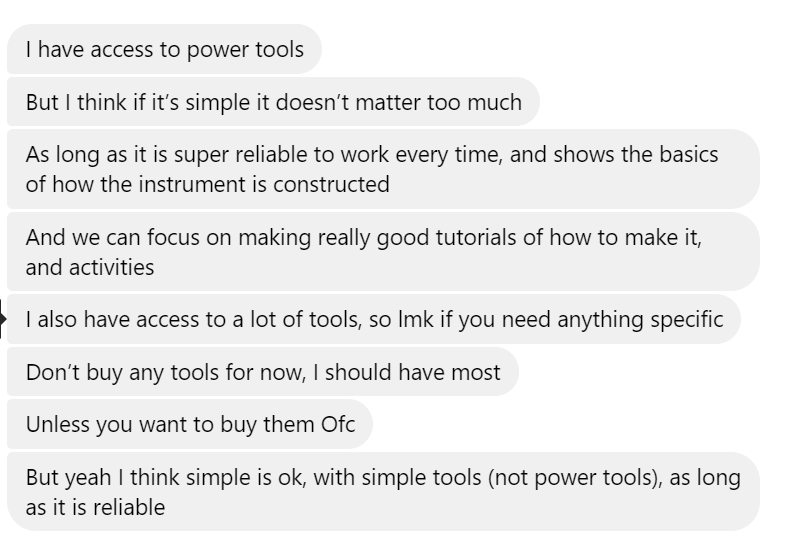
In the end, though we did consider maybe going down the route of using power tools, we ended up deciding to try our best in avoiding them and keeping the designs easy enough for primary school children which would still challenge them and leave them with playable instruments.
So, to summarise, Lucy and I will try to build instruments that are complex enough in design but simple enough for students. Also no power tools. Easy, right? 😅
 Exploring Technology in Music Education